Recent news from The Johns Hopkins University
This section contains regularly updated highlights of the news from around The Johns Hopkins
University. Links to the complete news reports from the nine schools,
the Applied Physics Laboratory and other centers and institutes are to
the left, as are links to help news media contact the Johns Hopkins
communications offices.
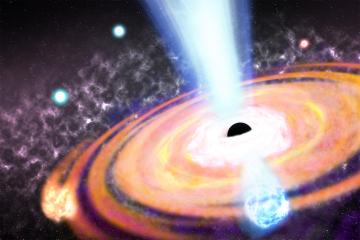
They say that a picture is worth a thousand words, and in the case of an image created by astrophysicist Miguel Angel Aragon of The Johns Hopkins University, the adage holds true. His vibrant computer illustration, which won the National Science Foundation’s 2011 Science and Engineering’s Visualization Challenge in the “Informational Posters and Graphics” category, brings to vivid life many dynamic aspects of the universe, spanning 240 million light years.
February 2, 2012 Tags: AAAS, Adler Planetarium, dark matter Science, Gordon and Betty Moore Foundation, Henry A. Rowland Department of Physics and Astronomy, Julieta Aguilera, Mark Subbarao, Miguel Angel Aragon, National Science Foundation, The Cosmic Web, The Johns Hopkins University, The National Science Foundation;s 2011 Science and Engineering's Visualization Challenge, the universe
| Category: Academic Disciplines, Homewood Campus News, Institutional News, Physics and Astronomy, Technology
Should the disputed Falkland Islands be returned to Argentina? In his latest article for Globe Asia, titled “The Falklands and other dangerous disputed territories – a market solution,” Steve Hanke, a professor of applied economics at The Johns Hopkins University, writes that a market solution could help Britain and Argentina avoid another war.
February 2, 2012 Tags: Argentina, Falkland Islands, Prince William, Steve Hanke
| Category: Business and Economics, International Affairs
Working together, experimental and computational scientists at The Johns Hopkins University and McNeese State University in Louisiana have determined that for lead sulfide, the smallest nano-crystal (cluster) with the same structural (coordination) properties as the bulk occurs when 32 units of lead sulfide, PbS, molecules assemble together. Their results were published in the Journal of Chemical Physics and The Virtual Journal of Nanoscale Science & Technology.
February 2, 2012 Tags: baby crystals, crystal structure, Department of Chemistry, Department of Energy, Howard Fairbrother, Journal of Chemical Physics, Kit Bowen, Krieger School of Arts and Sciences, lead sulfide, McNeese State University, nanoscale structures, PBS, photo-voltaics, STM, The Johns Hopkins University, Virtual Journal of Science & Technology
| Category: Academic Disciplines, Homewood Campus News, Natural Sciences, University-Related