About Johns Hopkins
Johns Hopkins University

Recent news from The Johns Hopkins University

This section contains regularly updated highlights of the news from around The Johns Hopkins University. Links to the complete news reports from the nine schools, the Applied Physics Laboratory and other centers and institutes are to the left, as are links to help news media contact the Johns Hopkins communications offices.


Armada Hoffler, Beatty Development Group will develop JHU project in Charles Village

The Johns Hopkins University has chosen a team headed by Baltimore- and Virginia-based Armada Hoffler to develop a mixed-use retail and residential complex with garage parking on university-owned land in the 3200 block of St. Paul Street in Charles Village.

“Please Touch” exhibition invites visitors to interact with objects in the name of science

The Program in Museums and Society, Department of Neuroscience, and Sheridan Libraries at The Johns Hopkins University announce the opening of Please Touch: An Interactive Study on the Neurological Mechanisms of Tactile Aesthetics in the quad-level lobby of the Milton S. Eisenhower Library on the Homewood campus. Curated by Hannah Weinberg-Wolf, a senior in the David S. Olton Program in Behavioral Biology, this exhibition introduces visitors to the neuroaesthetics of touch and aims to gather useful data from participants.

Johns Hopkins Engineer Mark Foster Wins NSF CAREER Award

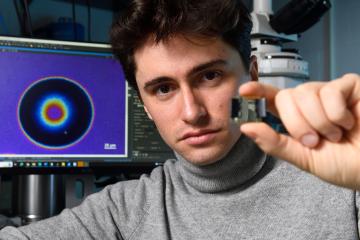
A Johns Hopkins engineer who is developing a high-speed imaging system designed to enable researchers to continuously record images at a rate of more than 100 million frames per second – 100 times more rapidly than current technology allows – has been awarded the National Science Foundation’s prestigious Faculty Early Career Development (CAREER) Award, a five-year, $400,000 grant.

Oceans 2013: Johns Hopkins Scientist Says Circulation Changes Due to Ozone Thinning

According to a Johns Hopkins earth scientist, the hole in the Antarctic ozone layer has caused changes in the way that waters in those southern oceans mix – a situation that has the potential to alter the amount of CO2 in the atmosphere and eventually could have an impact on global climate change. In a paper published in today’s issue of the journal Science, Darryn W. Waugh and his team show that subtropical intermediate waters in the southern oceans have become “younger” as the upwelling, circumpolar waters have gotten “older” – changes that are consistent with the fact that surface winds have strengthened as the ozone layer has thinned.

Johns Hopkins senior Lay Kodama wins Churchill Scholarship

Lay Kodama, a Johns Hopkins University senior from Columbus, Ohio, has been selected as a Churchill Scholar by the Winston Churchill Foundation of the United States. The Churchill Scholarship is awarded to 14 students nationwide who have demonstrated a capacity to contribute to the advancement of knowledge in the sciences, engineering or mathematics by completing original, creative work at an advanced level.

Johns Hopkins senior Tiras Lin wins Churchill Scholarship

Tiras Lin, a Johns Hopkins University senior from San Rafael, Calif., has been selected as a Churchill Scholar by the Winston Churchill Foundation of the United States.

WMAP Team Releases Final Results, Based on Nine Years of Observations

ince its launch in 2001, the Wilkinson Microwave Anisotropy Probe (WMAP) space mission has revolutionized our view of the universe, establishing a cosmological model that explains a widely diverse collection of astronomical observations. Led by Johns Hopkins astrophysicist Charles L. Bennett, the WMAP science team has determined, to a high degree of accuracy and precision, not only the age of the universe, but also the density of atoms; the density of all other non-atomic matter; the epoch when the first stars started to shine; the “lumpiness” of the universe, and how that “lumpiness” depends on scale size. Now, two years after the probe “retired,” Bennett and the WMAP science team are releasing its final results, based on a full nine years of observations.

Johns Hopkins to Give $10 million to Homewood-area Neighborhoods

The Johns Hopkins University will contribute $10 million over five years to enhance and strengthen neighborhoods surrounding the university’s Homewood campus in northern Baltimore City, President Ronald J. Daniels announced.

MEDIA ADVISORY: Only Mousetraps and Rubber Bands Will Power Student Devices in ‘Cable Car’ Contest

In this competition involving freshman engineers’ inventions, batteries are NOT required – or even allowed. For a class assignment, 67 students from an introductory mechanical engineering course have built aerial vehicles that must move across elevated cables and drop a “payload” onto a bull’s-eye target five feet below. The challenge: these cable cars can possess no motors or batteries. All movement must come from mousetraps and rubber bands.

Johns Hopkins Mathematicians Named Inaugural American Mathematical Society Fellows

Ten Johns Hopkins University mathematicians have been named Fellows of the American Mathematical Society for 2013, the program’s first year. The designation recognizes those who have made outstanding contributions to the creation, exposition, advancement, communication and utilization of mathematics.

Exposure to Light at Night May Cause Depression, Learning Issues, JHU Biologist Says

For most of history, humans rose with the sun and slept when it set. Enter Thomas Edison, and with a flick of a switch, night became day, enabling us to work, play and post cat and kid photos on Facebook into the wee hours. However, according to a new study led by Johns Hopkins biologist Samer Hattar, this typical 21st- century scenario comes at a serious cost: When people routinely burn the midnight oil, they risk suffering depression and learning issues, and not only because of lack of sleep. The culprit could also be exposure to bright light at night from lamps, computers and even iPads.

JHU Physicist Inaugural Winner of 2012 Prize of the Asian Union of Magnetics Societies

Chia-Ling Chien, the Jacob L. Hain Professor of Physics and the Director of the Material Research Science and Engineering Center at The Johns Hopkins University, is a winner of the first-ever Asian Union of Magnetic Societies Award, recognizing his “seminal contribution to magnetic materials, nanostructures, magnetoelectronic phenomena and devices.”

JHU’s Ménard named “Maryland’s Outstanding Young Scientist of 2012” by the Maryland Academy of Sciences

Astrophysicist Brice Ménard of the Johns Hopkins University has been selected by the Maryland Academy of Sciences as the Outstanding Young Scientist of 2012. He received the award at a ceremony to be held at the Maryland Science Center yesterday. Ménard, an assistant professor in the Henry A. Rowland Department of Physics and Astronomy, was recognized for his research in extragalactic astrophysics and cosmology.

MEDIA ADVISORY: Johns Hopkins students gathering to watch final presidential debate

With just over two weeks to go before election day, undergraduates at Johns Hopkins University will gather to watch the third and final presidential debate Monday night.

Royal Society Research Professor to Give Annual Benton Lecture at Johns Hopkins

October 17, 2012 FOR IMMEDIATE RELEASE MEDIA CONTACT:  Lisa De Nike (443)-287-9960 (office) (443) 845-3148 (cell) Lde@jhu.edu Andrew Watson, a Royal Society research professor who studies the carbon cycle and its connection climate change, will give the George S. Benton Endowed Lecture in Meteorology and Fluid Dynamics at The Johns Hopkins University at 4 p.m. [...]

MEDIA ADVISORY: Johns Hopkins students gathering to watch presidential debate

Johns Hopkins undergraduates from the College Democrats, College Republicans and a weekly opinion magazine called JHU Politik are hosting a non-partisan presidential debate-watching party tonight, Tuesday, Oct. 16, at 9 p.m., at Nolan’s on 33rd dining hall, located at 3301 N. Charles St. in Baltimore.

Johns Hopkins Chemist Wins Packard Fellowship

Johns Hopkins University chemist Tyrel McQueen has been awarded a 2012 David and Lucile Packard Foundation Fellowship for Science and Engineering. The fellowship is one of 16 awarded each year nationwide, and bestows unrestricted funds of $875,000 (over a five-year period) to unusually creative young faculty members in science and engineering.

MEDIA ADVISORY: Johns Hopkins students gathering to watch vice presidential debate

Undergraduates whose beliefs span the political spectrum will gather to watch Thursday night’s debate between Vice President Joe Biden and Paul Ryan, the Republican candidate for vice president.

JHU Cosmologists Receive “New Frontiers” Award for Work on “Origami Universe”

Two Johns Hopkins University research scientists who use the Japanese art of paper folding, known as origami, as a metaphor for understanding the complexity of the cosmos have been named winners of an award through the “New Frontiers in Astronomy & Cosmology International Grant and Essay Writing Competition,” funded by the John Templeton Foundation. Mark Neyrinck and Miguel Aragón-Calvo, both of the Henry A. Rowland Department of Physics and Astronomy at the Johns Hopkins University’s Krieger School of Arts and Sciences, were chosen from an international competition led by the University of Chicago’s Donald G. York to receive a grant to explore fundamental questions in astronomy and cosmology that engage groundbreaking ideas on the nature of the universe

Mark Dion installation featured in Johns Hopkins University’s new library building

Pieces of Johns Hopkins University’s past have a permanent and prominent place in the present, thanks to a new, expansive art installation inside the Brody Learning Commons.

Johns Hopkins Receives $7.4 Million Grant to Boost STEM Education in Baltimore City

Supported by a five-year $7.4 million National Science Foundation grant, experts at The Johns Hopkins University are partnering with teachers and administrators in Baltimore City Public Schools on a program to enhance teaching and learning in science, technology, engineering and math in city elementary schools by making STEM a community affair. The program, called STEM Achievement in Baltimore Elementary Schools – SABES for short — not only will benefit more than 1,600 students in grades three through five in nine city elementary schools, but could also become a national model for science, technology, engineering and math education.

Johns Hopkins Astrophysicist Spies Ultra-Distant Galaxy Amidst Cosmic ‘Dark Ages’

With the combined power of NASA’s Spitzer and Hubble Space Telescopes as well as a cosmic magnification effect, a team of astronomers led by Wei Zheng of The Johns Hopkins University has spotted what could be the most distant galaxy ever seen. Light of the young galaxy captured by the orbiting observatories shone forth when the 13.7-billion-year-old universe was just 500 million years old. The far-off galaxy existed within an important era when the universe began to transit from the so-called “Dark Ages.” During this period, the universe went from a dark, starless expanse to a recognizable cosmos full of galaxies. The discovery of the faint, small galaxy accordingly opens up a window into the deepest, remotest epochs of cosmic history.

“This galaxy is the most distant object we have ever observed with high confidence,” said Zheng, a principal research scientist in The Henry A. Rowland Department of Physics and Astronomy at Johns Hopkins’ Krieger School of Arts and Sciences and lead author of a new paper appearing in Nature tomorrow. “Future work involving this galaxy – as well as others like it that we hope to find – will allow us to study the universe’s earliest objects and how the Dark Ages ended.”

Johns Hopkins Biologist Joel Schildbach Selected as PULSE Leadership Fellow

A Johns Hopkins biologist has been selected by the Partnership for Undergraduate Life Sciences (PULSE) as one its new Vision and Change Leadership Fellows, a group charged with spending a year identifying and recommending ways to improve undergraduate life sciences education. Joel Schildbach, a biology professor and director of undergraduate studies at Johns Hopkins’ Krieger School of Arts and Sciences, is one of 40 faculty members selected from 250 applicants from 24 states and the U.S. Virgin Islands by PULSE, a joint initiative of the National Science Foundation, the Howard Hughes Medical Institute and the National Institutes of Health.

Children of immigrants are coming out ahead of their peers

Children of immigrants are outperforming children whose family trees have deeper roots in the United States, learning more in school and then making smoother transitions into adulthood, according to sociologists at The Johns Hopkins University.

Air Force Launches New Center at Johns Hopkins to Advance Structural Materials and Design for Aerospace Applications

The U.S. Air Force has selected a team led by Johns Hopkins engineers to start a new materials research center of excellence that will develop novel computational and experimental methods to support the next generation of military aircraft. The Center of Excellence on Integrated Material Modeling, CEIMM, will advance the Computational Integrated Materials Science and Engineering Initiative, which focuses on materials applications within a digital framework.

events calendar
click to view events calendar
browse Johns Hopkins A-Z
click to browse
on the web
  • click for hopkins on Facebook
  • click for hopkins on Twitter
  • click for hopkins on YouTube
  • click for hopkins music