Recent news from The Johns Hopkins University
This section contains regularly updated highlights of the news from around The Johns Hopkins
University. Links to the complete news reports from the nine schools,
the Applied Physics Laboratory and other centers and institutes are to
the left, as are links to help news media contact the Johns Hopkins
communications offices.
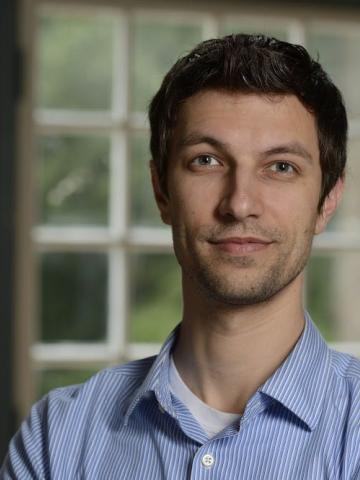
Johns Hopkins astrophysicists Brice Ménard and Charles L. Bennett have been appointed to the Euclid Consortium, the international team of scientists overseeing an ambitious space telescope project designed to probe the mysteries of dark energy and dark matter. NASA, a partner in the mission, recently announced their selection to the research team for Euclid.
February 12, 2013 Tags: astronomy, Brice Ménard, Charles Bennett, dark energy, dark matter, Euclid space telescope, European Space Agency, NASA
| Category: Homewood Campus News, Physics and Astronomy, Technology
ince its launch in 2001, the Wilkinson Microwave Anisotropy Probe (WMAP) space mission has revolutionized our view of the universe, establishing a cosmological model that explains a widely diverse collection of astronomical observations. Led by Johns Hopkins astrophysicist Charles L. Bennett, the WMAP science team has determined, to a high degree of accuracy and precision, not only the age of the universe, but also the density of atoms; the density of all other non-atomic matter; the epoch when the first stars started to shine; the “lumpiness” of the universe, and how that “lumpiness” depends on scale size. Now, two years after the probe “retired,” Bennett and the WMAP science team are releasing its final results, based on a full nine years of observations.
December 21, 2012 Tags: Adam G. Riess, age of the universe, baby picture of the universe, big bang theory, Charles L. Bennett, dark energy, Gary Hinshaw, the density of atoms, University of British Columbia, Wilkinson Microwave Anisotropy Probe, WMAP
| Category: Academic Disciplines, Homewood Campus News, Institutional News, Physics and Astronomy, University-Related
Adam Riess, a professor in physics and astronomy at The Johns Hopkins University and a research scientist at the Space Telescope Science Institute, today accepted the 2011 Nobel Prize in physics from the Royal Swedish Academy of Sciences during a ceremony in Stockholm, Sweden.
December 10, 2011 Tags: accelerating universe, Adam G. Riess, Adam Riess, dark energy, Nobel Prize, Nobel Prize in Physics, Space Telescope Science Institute, supernovae, The Johns Hopkins University, the Krieger School of Arts and Sciences
| Category: Academic Disciplines, Homewood Campus News, Institutional News, Physics and Astronomy, University-Related
Members of the last crew to fly aboard the Space Shuttle “Endeavour” — the second-to-the-last flight in NASA’s space shuttle program — will discuss their mission to the International Space Station from 6:30 to 9 p.m. on Thursday, August 4, at The Johns Hopkins University’s Homewood campus. Presented by the Maryland Space Grant Consortium and NASA, the event is free and open to the public. The crew will give a video presentation about the mission and answer questions from the audience in the Bloomberg Center for Physics and Astronomy’s Schafler Auditorium, on the campus’s north end. Free parking is available in the Muller parking deck on San Martin Drive, adjacent to Bloomberg.
July 28, 2011 Tags: antimatter, astrophysicists, Bloomberg Center for Physics and Astronomy, dark energy, European Space Agency, Homewood campus events, International Space Station, Mark Kelly, Maryland Space Grant Consortium, NASA, Rep. Gabrielle Giffords, Schafler Auditorium, space shuttle, Space Shuttle Endeavour, spacewalks, strange matter, STS-134
| Category: Academic Disciplines, Events Open to the Public, Homewood Campus News, Physics and Astronomy, University-Related
Adam Riess, an astrophysicist at The Johns Hopkins University and the Space Telescope Science Institute, today was awarded the Einstein Medal 2011 by the Albert Einstein Society of Bern, Switzerland. The society board of trustees recognized Riess for leadership in the High-z Supernova Search Team’s 1998 discovery that the expansion rate of the universe is accelerating, a phenomenon widely attributed to a mysterious, unexplained “dark energy” filling the universe. Riess, 41, shares this year’s prize with Saul Perlmutter, an astrophysicist at the University of California, Berkeley and the Lawrence Berkeley Laboratory, whose Supernova Cosmology Project team published similar results shortly after those published by Riess and High-z teammate Brian Schmidt, of the Australian National University.
February 18, 2011 Tags: Adam Riess, Australian National Laboratory, Bern, dark energy, Einstein Medal, Henry A. Rowland Department of Physics and Astronomy, High-z Supernova Search Team, Lawrence Berkeley Laboratory, Peter Gruber Foundation, Saul Perlmutter, Shaw Prize, Space Telescope Science Institute, Supernova Cosmology Project, The Albert Einstein Society, The Johns Hopkins University, University of California Berkeley
| Category: Academic Disciplines, Homewood Campus News, Institutional News, Physics and Astronomy